We believe foreign interference is the reason RightsCon 2026 won’t proceed in Zambia or online.
rightscon.org, 1 May 2026
China, Taiwan and the cancellation of the RightsCon 2026 in Zambia
Something noteworthy happened in late April/early May. Or rather, the fact that something did not happen makes it noteworthy.
The RightsCon 2026, one of the worlds largest conferences on human rights in the digital age, was scheduled to take place from 5-8 May in Lusaka, Zambia.
According to the organisers, US-based non-governmental organisation Access Now, several thousand people from over 150 countries and 750 institutions were expected to participate in person and online. RightsCon has been addressing digital and human rights issues since 2011. Last year’s summit took place in Taipei, Taiwan.

Some of this year’s key topics:
- Freedoms and Agency in the Age of Surveillance
- Freedom of the Media
- Internet Shutdowns and Disruptions
- Tactics and Contexts for Activists
On 28 April 28, the organisers posted „1 Week to go“:

The 14th RightsCon was to convene at the Mulungushi International Conference Center (MICC) in the Zambian capital. Reopened after refurbishments in 2022,
the MICC is one of Zambia’s premier venues for hosting national and international conferences, exhibitions, and events. (MICC website)
This premier venue is also one of more than 300 projects in Zambia financed by the People’s Republic of China (PRC). More on this further below.
The MICC could easily have facilitated the roughly 2,600 participants; and the Zambian economy would have benefited from the influx of visitors.
Eventually, the matter took an unexpected turn. After one year of planning and just a few days before its official opening, the government decided to „postpone“ the summit.
RightsCon 2026: „postponement“ due to „security concerns“
The arguments behind the Zambian governments‘ decision are mentioned in a statement published by the organisers on 1 May.
On April 27, one day after a government press release endorsed RightsCon, we received a phone call from Ministry of Technology and Science about an urgent issue and were told that diplomats from the People’s Republic of China (PRC) were putting pressure on the Government of Zambia because Taiwanese civil society participants were planning to join us in person.
By citing „security concerns“ and a „lack of information on the topics to be discussed“, the Zambian government justified its last-minute decision. The authorities therefore demanded “comprehensive disclosure of critical information” to guarantee alignment with Zambia’s “national values and policy priorities“.
The organisers argue the decision came sudden and unexpected, as they
had spent months liaising with the government to ensure transparency and mutual understanding around the conference.
We invested months in building government relationships focused precisely on transparency and mutual understanding, including explicit conversations about the diversity of our community. If this foundation was somehow deemed insufficient, we are left to ask: why was that not communicated to us earlier, rather than only five days before our participants were due to arrive?
Ultimately, there were only two options left. To either exclude all Taiwanese participants and cancel all related events to get permission. Or to cancel the entire conference.
The organisers opted for the latter:
This was our red line. Not because we were unwilling to engage, but because the conditions set before us were unacceptable and counter to what RightsCon is and what Access Now stands for. The manner of the government’s communications process this week also raised serious questions as to the integrity, forthrightness, and value of any future engagement based on good faith.
We see this unilateral decision, and the way it was taken, as evidence of the far reach of transnational repression targeting civil society, and effectively shrinking the spaces in which we operate.
The origin of this „far reach of transnational repression“? According to Access Now’s co-executive director:
[M]ultiple pieces of information we received indicated that foreign interference by the People’s Republic of China played a role in the abrupt disruption of RightsCon 2026.
No RightsCon 2026 – more voices
The Office of the United Nations High Commissioner for Human Rights:
Any restriction on peaceful assembly must meet the criteria of legality, necessity, and proportionality. The government’s decision fails on all counts. By demanding “comprehensive disclosure of critical information” to ensure alignment with “national values and policy priorities,” the Zambian authorities have committed a clear violation of the rights to freedom of assembly, association, and expression. This grants the state overbroad discretion to stifle dissent and creates a pervasive chilling effect, signalling that collective action is a conditional privilege rather than an inherent right. […]
This decision sets a deeply worrisome precedent for the hosting of international assemblies worldwide. The Zambian action signals to the international community that the right to peaceful assembly and of association is now subject to political vetting and administrative whims.
To Amnesty International, the controversy appears to be „a brazen act of Chinese transnational repression“. A look at some of the more than 500 scheduled panels gives an idea of how certain topics might have offended the Chinese side:
Several China-related themes were on the conference agenda in Lusaka, including Uyghur forced labour in global supply chains, the China-Russia authoritarian nexus, Chinese surveillance, the digital reach of China’s Belt and Road Initiative, cybersecurity “with Chinese characteristics” and the export of authoritarian norms. In addition to Taiwanese civil society, a number of members of diaspora groups, including Hongkongers, Tibetans and Uyghurs as well as mainland Chinese, were expected to attend.
Several European Organisations published an open letter:
The de facto cancellation of RightsCon is in contradiction with the democratic standards enshrined in the International Covenant on Civil and Political Rights, and indeed the Constitution of Zambia, most notably freedom of expression and freedom of assembly. […] It also contributes to the global trend of repression of civil society, already weakened by significant funding cuts and legislation limiting civic space.
Others cite internal political reasons related to the upcoming general election in Zambia this August:
In the run-up, the government has steadily been putting in place laws that make it easier to win and entrench power post-election. Political parties and civil society have been denied the opportunity to meet in public.
No RightsCon 2026 – the Chinese view
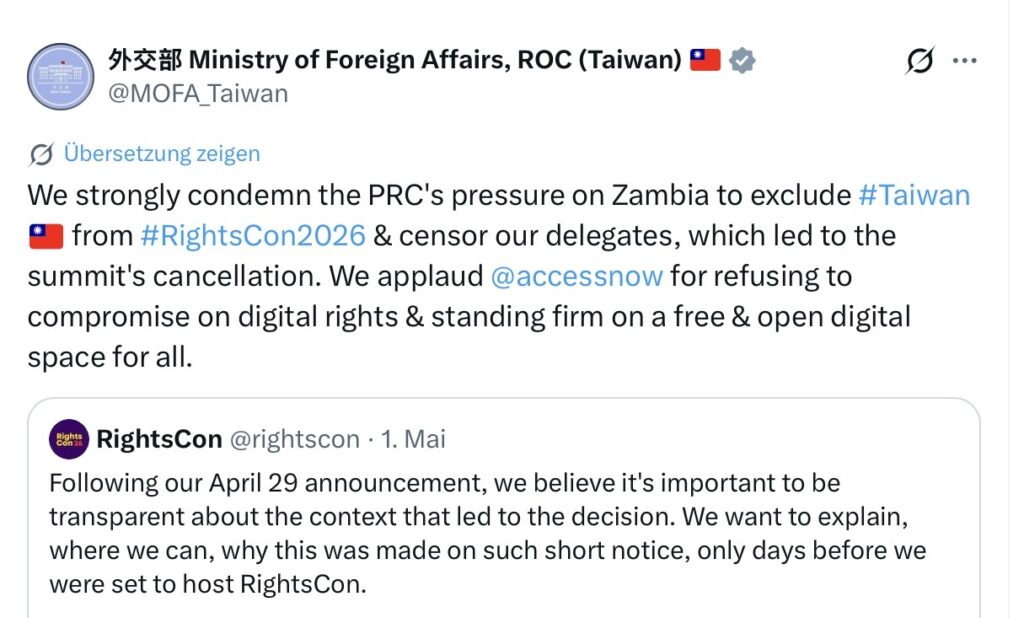
Searching for the key word „RightsCon“ in the world of mainland Chinese state media yields unsurprisingly few results. To be precise, none at all.
Xinhua News Agency:
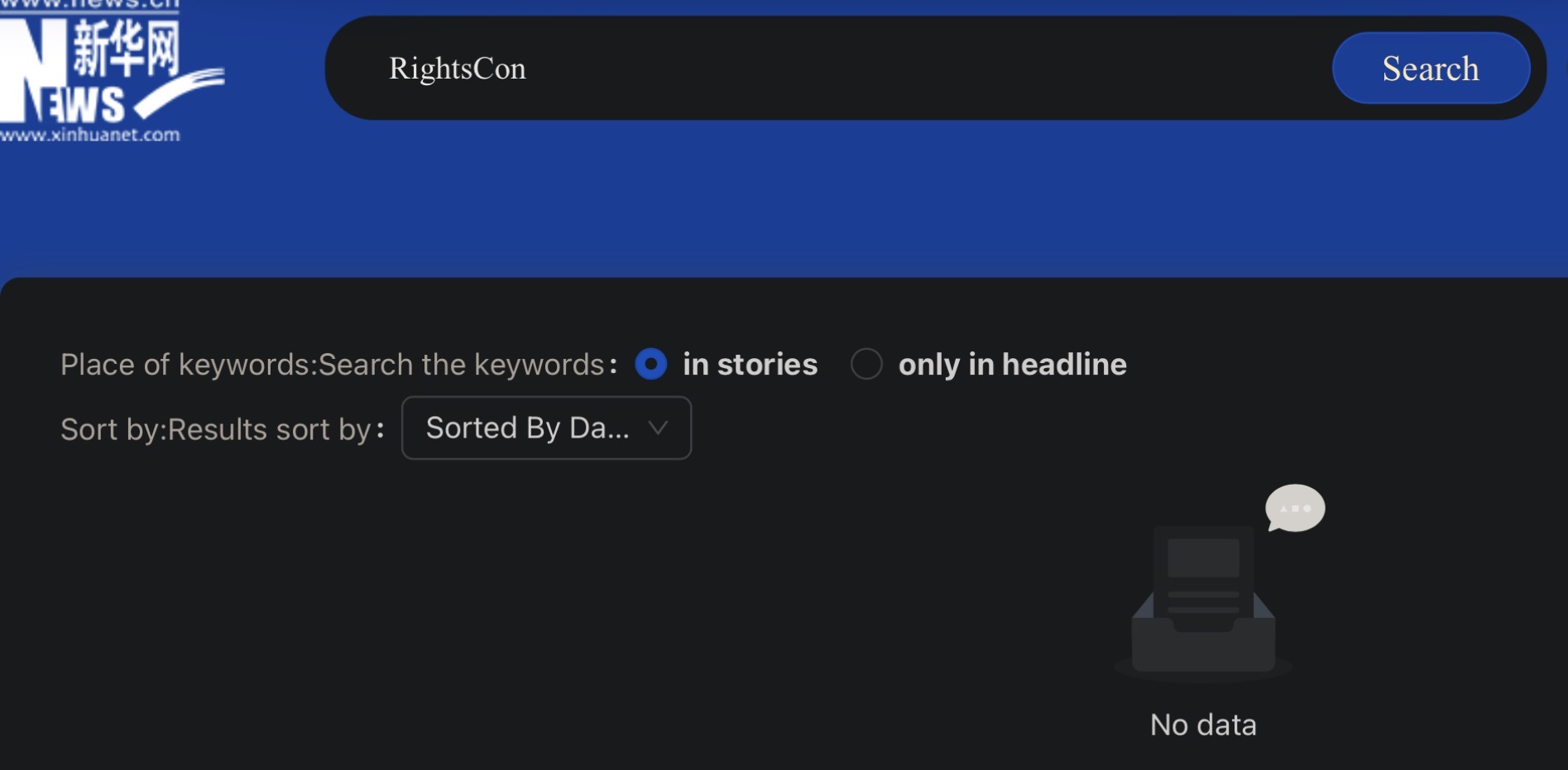
Global Times:
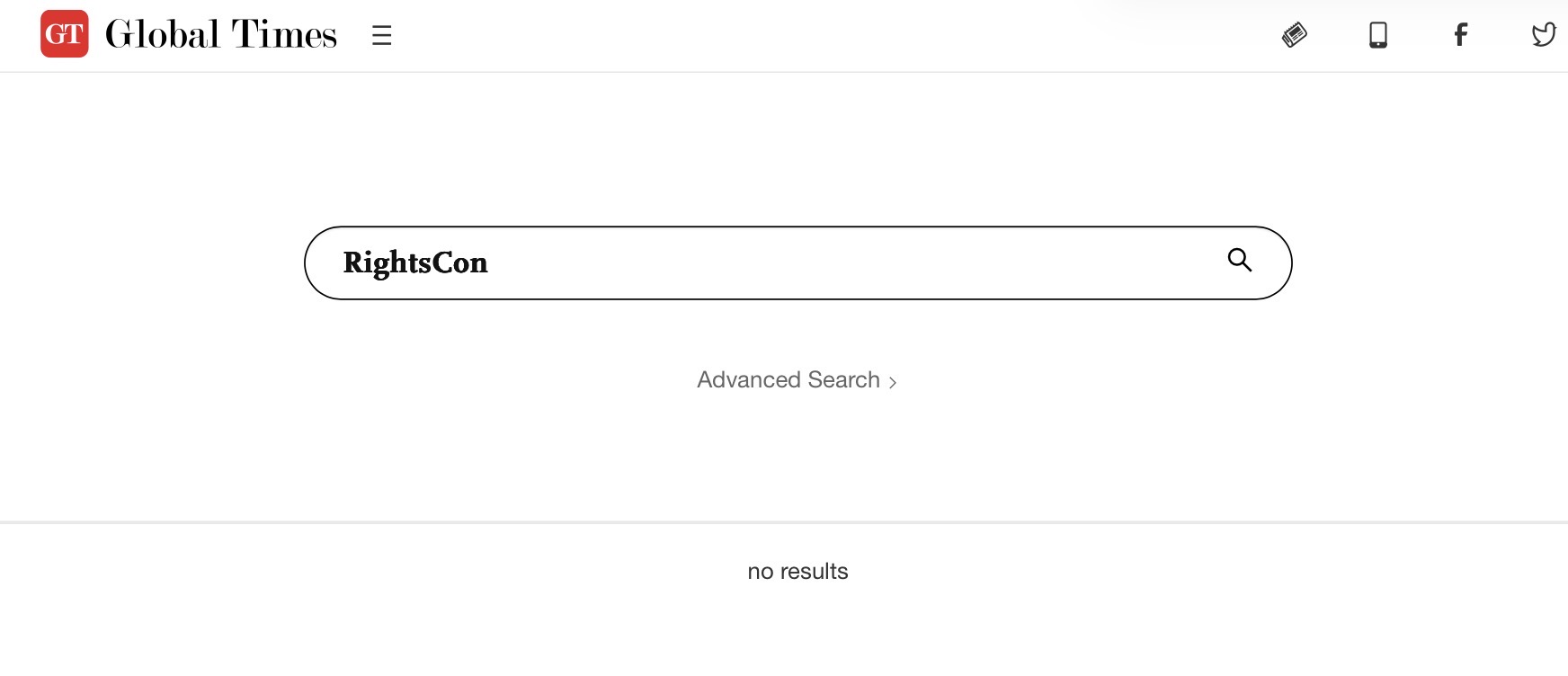
No results, no data.
Advocacy of „western“ human rights, minority rights or related topics, is something that does not exist in the mainstream media. Instead, Chinese state media prefer to highlight positive developments and promote the well-known narrative of harmony and win-win situations.
No topic, no controversy?
A search for „RightsCon 2026“ and „赞比亚“ (Zambia) on the Chinese Intranet via Baidu, China’s largest search engine, produced a few results with similar content. The following excerpt is from an article published on news portal 163:
Access Now’s response highlights a classic dilemma faced by international event organizers—the government has already made its position clear through the media, yet the organizers claim they “have not yet received official communication.”
The author identifies a „classic dilemma“ and concludes: „this disconnect in information is intriguing.“ Ultimately, the US is identified as the root cause of such developments, as the Trump administration was responsible for a „backlash against academic research in digital rights“. The article propagates an alternative narrative by omitting vital information, facts and context. For example:
- the event had been planned for a year and was postponed only a few days beforehand.
- communication between the organisers and the Zambian government
- references to Taiwan and mainland China
- the question of foreign interference.
The second excerpt is from an AI-generated summary provided by search engine Baidu AI:
Why Was It Suddenly Canceled?
Official Statement: The Zambian government stated that the postponement was due to “unfinished procedures,” as administrative and security clearances for some speakers and participants had not yet been completed, and more time was needed to ensure the conference complied with national procedures and values.
Organizer’s Statement: The organization Access Now pointed out that the primary reason for the cancellation was foreign interference. They claim to have received information that the Zambian government faced external pressure to exclude activists from Taiwan from attending, and the organizers’ opposition to this exclusion led to the breakdown of cooperation.
Underlying Reasons: Analysts believe that the conference’s agenda, which covers sensitive topics such as internet surveillance and digital sovereignty, conflicts with the host government’s regulatory stance. The Zambian government may have sought to use a “technical delay” to avoid direct conflict while maintaining its international image.
The Baidu AI summary is linked to a source text from AP Africa that is available in both English and Chinese. The AP Africa source text explicitly mentions Taiwan, and also cites China as the country associated with foreign interference.
When comparing these two search results, the Baidu AI summary provides more information than the 163 article, offering a more detailed overview. While Baidu AI mentions Taiwan, 163 does not. And while the Baidu AI summary does mention Taiwan, it still omits any information related to the PRC.
Both examples illustrate the tightly regulated environment of the Chinese internet in which humans and Baidu AI, like any other AI Made in China, operate. „Socialist core values“ act as guardrails to obliterate any
- criticism of the state and the party
- criticism of Xi Jinping
- mentioning of the „three T’s“ (Taiwan, Tibet, Tiananmen).
China-Africa cooperation: An „all-weather community with a shared future for the new era“
While the RightsCon 2026 was being cancelled, China announced good news for China-Africa cooperation. A new zero-tariff agreement between China and 53 African countries came into effect on 1 May. The following is an excerpt from the Foreign Ministry’s press conference:
China noted the earnest expectation and positive feedback from Africa regarding the zero-tariff treatment. This is an important measure of China taking the initiative to expand unilateral opening up. It demonstrates China’s willingness to shoulder more international obligations and steadily expand high-standard opening up. It is a vivid example of how China upholds the principle of sincerity, real results, amity and good faith and the principle of pursuing the greater good and shared interests with Africa, and how China and Africa jointly build an all-weather China-Africa community with a shared future for the new era. It can well be said that the policy is epoch-making in the history of China-Africa relations and international relations.
Xiplomacy is the keyword for China-Africa Cooperation.
China and Zambia: close ties since the 1970s
Over the last fifty years, the relations between China and Zambia have developed steadily. Some key facts:
- Bilateral ties started developing in the 1970’s, when Chinese-aided construction of the TAZARA (Tanzania-Zambia-Railway) project began.
- During his visit to Zambia in 2025, Chinese Premier Li Qiang signed a $1.1 Billion agreement with Tanzania and Zambia to modernise the 1,860 km-long railway line.
- In April, both countries signed a development cooperation agreement. Part of this cooperation is a $1.5 Billion contract with a Chinese state owned company to expand Zambia’s electricity network.
- About 400 Zambian officials and technical personnel received training in China in 2025.
- China is Zambia’s largest creditor, owing the PRC about $5.7 Billion.
- Comprehensive strategic partnership with China since 2023.
- Companies like Huawei and Hikvision are at the forefront of providing „Smart City“ or „Safe City“ technology and surveillance tools.
- Zambia has been a recipient of large-scale Chinese aid and investment. From 2000 to 2023, China invested about $15 Billion in loans and grants, as well as in infrastructure and communication projects.(aiddata.org, Reuters), Xinhua)
In 2018, when Chinese President Xi Jinping headed the Forum on China-Africa Cooperation, he announced a $30 million grant for the modernisation of the MICC. It is speculated that the original amount, a „gift“ with „no strings attached“, has doubled over the years. (HRW, aiddata.org)
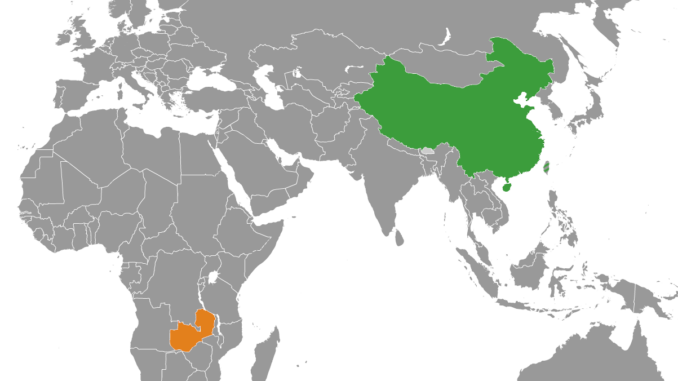
Today, there are more than 300 projects in Zambia financed by China, including airports, roads and mines. The visible changes in Zambia are similar to those in many other countries along the new Belt-and-Road network:
The Chinese presence in Zambia is ubiquitous: driving through Lusaka and in the provinces, one sees Chinese restaurants, banks, medical clinics and large China Malls carrying a wide range of affordable, cheaply made Chinese goods labeled in English.(thediplomat)
China’s visible influence in Zambia
A documentary highlighting the negative consequences of China’s commercial presence gained attention when the Chinese Chamber of Commerce in Zambia tried to prevent it from airing.

According to the current World Press Freedom Index published by Reporters Without Borders, Zambia ranks 77th. The organisation has been documenting China’s growing presence on the continent:
The African continent is a strategic region for China’s expanding influence, and the Chinese Communist Party has invested in the region’s news outlets, media advertising, and training for African journalists to promote its narratives.
In 2023, Zambian President Hichilema spent almost one week in China and found the time to praise bilateral relations on Chinese television.

RightsCon 2026, China, Zambia and Taiwan – commentary
A much more confident and assertive China in foreign affairs and on the international stage, including the so-called Wolf Warrior diplomacy, has become a reality. Alongside its economic rise and growing influence, the PRC increasingly manages to incorporate its own norms and standards on a global level. This soft power influence – also referred to as „Chinese wisdom for the world“ – brings solid consequences for everyday life. The world is seemingly „becoming (more) Chinese“.
However, economic support rarely comes for free as a purely benevolent act. There are usually strings attached. Wether it’s loans, grants, gifts or aid, they can be tied to certain conditions, expectations and red lines. Should certain expectations not be met, various pressure points can be applied to achieve compliance.
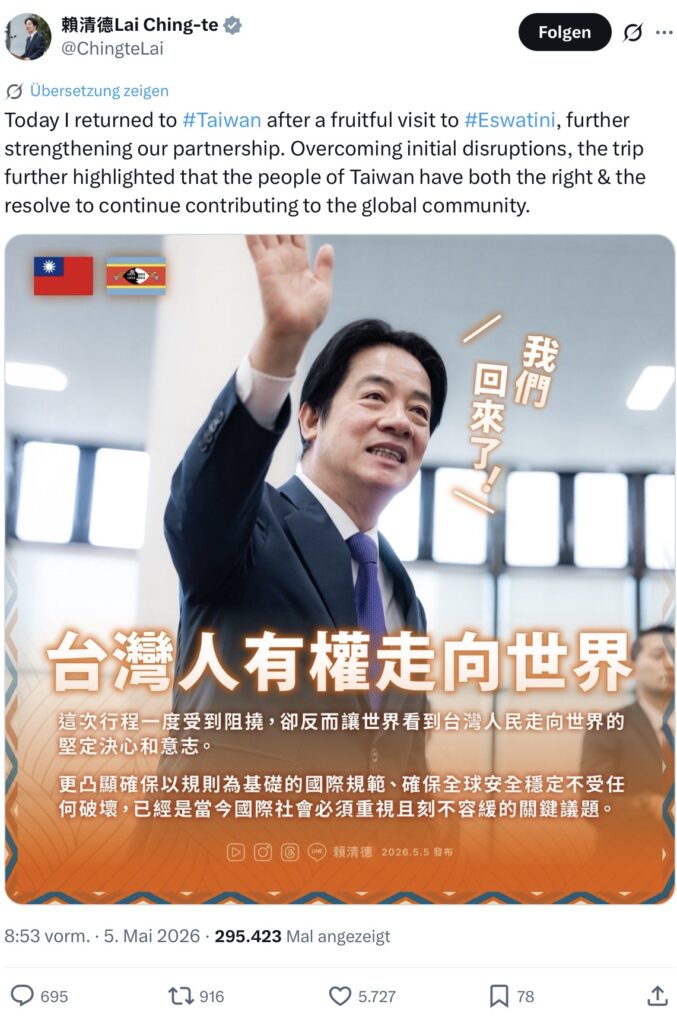
Within the China-Africa nexus, Taiwanese President Lai’s recent visit to Eswatini is allegedly an example of one state’s willingness and its ability to apply pressure beyond its own borders. Mr. Lai’s journey was complicated because three rather China-friendly countries denied him permission to fly through their airspace. A comment from the PRC’s Ministry of Foreign Affairs press conference, 2 May:
Just hours within the Yilan earthquake, Lai Ching-te ditched the people in Taiwan who were still reeling from the disaster and sneaked onto a foreign plane to “smuggle” himself out of the island, squandering taxpayers’ money and performing a laughable stunt in front of the world. That just added yet another episode to the scandalous “Taiwan independence” separatism. […]
We urge Eswatini and some other individual countries to see where the arc of history bends and stop serving as the prop of “Taiwan independence” separatists.
The kingdom of Eswatini is the only African country left to uphold diplomatic ties with Taiwan. It is also the only African country excluded from the above-mentioned tax regime.
Human rights under pressure worldwide
Contemporary mainland China often serves as a blueprint for an authoritarian state and a tightly-controlled society, where the space for civic engagement is small and shrinking. In recent years, the number of incidents where the PRC asserts pressure on Chinese nationals living abroad has risen. There is also an increase in aggressive activities aimed at influencing other states in political and economic matters.
Thanks to its decade-long engagement, the PRC is clearly in an influential position in Zambia. Like any powerful country, the PRC could dictate terms to a certain degree and exert influence well beyond its borders.
In such a worst-case scenario, the RightsCon 2026 in Zambia stands as an example of successfully applying extraterritorial state pressure to silence civil society movements.
Anyhow, there cannot be certainty without hard evidence. Until then, any of the above-mentioned accusations of „foreign interference“ and „transnational repression“ against the PRC in relation to the RightsCon 2026 remain speculative.
(last updated: 13 June 2026)
Sources
More articles in English.
More posts from Schöne Neue Welt.
163,全球最大数字人权大会为何被突然叫停?, https://www.163.com/dy/article/KRNNNG8H05561FZG.html.
DW, Taiwan’s Lai returns from Eswatini trip amid China objection, https://www.dw.com/en/taiwans-lai-returns-from-eswatini-trip-amid-china-objection/a-77046190.
RSF, https://rsf.org/en/country/zambia.
Xinhua, China, Zambia sign development cooperation agreement, https://english.news.cn/20260425/5a560e35817045868bd3ac1353437a08/c.html.
Antworten